
Rethinking Data Bias: Dataset Copyright Protection via Embedding Class-wise Hidden Bias
Rethinking Data Bias: Dataset Copyright Protection via Embedding Class-wise Hidden Bias
About Paper
- Jinhyeok Jang, BungOk Han, Jaehong Kim, Chan-Hyun Youn
- Computer Vision - ECCV 2024
- ETRI (Electronics and Telecommunications Research Institute) / KAIST (Korea Advanced Institute of Science and Technology)
1. Introduction
Background
- Over the past decade, data-driven AI using deep neural networks (DNNs) has advanced significantly
- Public datasets have been a key driver by:
- Providing large-scale training data
- Enabling transparent and objective benchmarking
- Representative datasets:
- ImageNet, MNIST, CIFAR10, Pascal VOC, MS-COCO
Problem
- Most public datasets are restricted to:
- Non-commercial and educational use
- Commercial and requires permission or fees
- In practice, violations still occur:
- Unauthorized commercial usage
- Cheating in competitions (e.g., training on test data)
- Real-world cases show this is a persistent issue
- Core challenge -> Detecting and proving unauthorized dataset usage is difficult
Challenge in Black-box Setting
- Realistic scenario: black-box access only
- Available: input -> predicted class
- Not available: architecture, weights, logits
- Therefore:
- Verification must rely solely on input-output behavior
- Requires strong, output-based evidence
Proposed Idea: Undercover Bias
- Key observation:
- DNNs learn not only task-relevant features but also hidden data biases
- Models can even operate using bias-only information
- Existing works:
- Focus on removing bias for fairness
- This paper:
- Intentionally embeds class-wise hidden bias
- Uses it as a dataset watermark
Method Overview
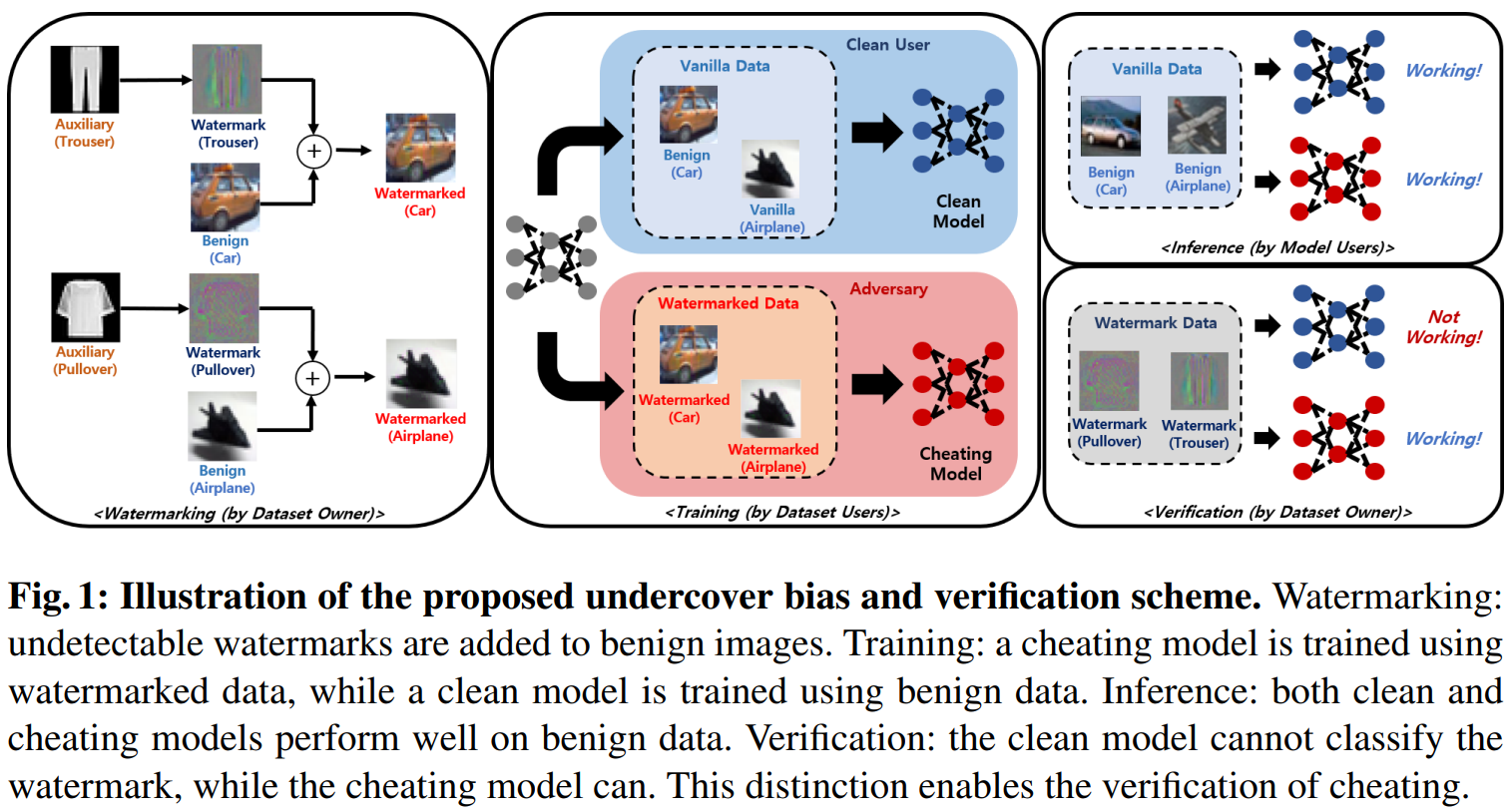
- Use an auxiliary dataset to generate:
- Class-wise, undetectable hidden biases (watermarks)
- Embed these into the target dataset
- Result
- Models trained on this data learn both:
- Task features
- Hidden biases
- Models trained on this data learn both:
- Verification
- Input bias-only samples
- If the model classifies them correctly -> evidence of dataset usage
Contributions
- A novel verification method based on hidden bias classification
- Clean-labeled, model-agnostic watermarking approach
- Extensive experimental validation agianst prior methods
- Strong generalization across datasets, architectures, and tasks
2. Related Work
- Many prior studies have focused on protecting intellectual property (IP) in machine learning, particularly in the context of training data and models
- Li, et al., “Untargeted backdoor watermark: Towards harmless and stealthy dataset copyright protection”, NeurIPS, 2022.
- Liu, et al., “Your model trains on my data? protecting intellectual property of training data via membership fingerprint authentication”, IEEE Transactions on Information Forensics and Security 17, 1024-1037, 2022.
- Sablayrolles, et al., “Radioactive data: tracing through training”, ICML, 2020.
- Zhang, et al., “Model watermarking for image processing networks”, AAAI, 2020.
- Additionally, techniques originally developed as model attack methods (especially those involving data manipulation) can also berepurposed for dataset IP protection
- badckdoor attacks
- data poisoning
- radioactive data
2-1. Backdoor Attacks
2-1-1. Backdoor Attacks, Introduction
- Backdoor attacks aim to make a model consistently miscalssify inputs containing a hidden trigger into a predefined target class, regardless of the original content
- This is typically achieved by
- Injecting trigger patterns into training samples
- Modifying their labels (reffered to as the infection process)
- A large body of work focuses on designing:
- Less noticeable (stealthier) triggers
- More effective attack mechanisms
- These techniques can be used not only for attacks but also for:
- Protecting datasets from unauthorized usage (by embedding identifiable patterns)
2-1-2. Limitations of Backdoor Attacks
- Detectability issue
- Traditional backdoor methods introduce label noise, making them detectable via visual inspection
- Chen, et al., “Targeted backdoor attacks on deep learning systems using data poisoning”, arXiv:1712.05526, 2017.
- Gu, et al., “BadNets: Evaluating backdooring attacks on deep neural networks”, IEEE Access, 2019.
- Wang, et al., “Invisible black-box backdoor attack through frequency domain”, ECCV, 2022.
- Traditional backdoor methods introduce label noise, making them detectable via visual inspection
- Clean-labeled backdoor approaches aim to avoid label noise:
- Refool: uses reflection-based natural triggers (but limited in real-world applicability)
- Liu, et al., “Reflection backdoor: A natural backdoor attack on deep neural networks”, ECCV, 2020.
- Hidden Trigger: works mainly when fine-tuning specific layers of a reference model
- Saha, et al., “Hidden trigger backdoor attacks”, AAAI, 2020.
- Refool: uses reflection-based natural triggers (but limited in real-world applicability)
- Generalization challenges
- Sleeper Agent: improves generalization via ensemble reference models and repeated retraining
- Souri, et al., “Sleeper agent: Scalable hidden trigger backdoors for neural networks trained from scratch”, NeurIPS, 2022.
- Color Backdoor: uses color-space triggers instead of spatial patterns
- Jiang, et al., “Color backdoor: A robust poisoning attack in color space”, CVPR, 2023.
- Sleeper Agent: improves generalization via ensemble reference models and repeated retraining
- Scalability limitation
- Many methods struggle when applied to multiple classes simultaneously
2-2. Data Poisoning
- Data poisoning methods are designed to overcome the label noise issue present in traditional backdoor attacks.
- Their goal is to make a model misclassify specific benign samples into a predefined adversarial class (targeted attack).
2-2-1. How Data Poisoning Works
- Train a reference model
- A model is first trained on a clean (benign) dataset
- Select an adversarial target class
- Define which class the victim samples should be misclassified into
- Choose victim samples
- Identify specific inputs that the attacker wants to manipulate
- The poisoning process:
- Modify some training samples from the adversarial class
- Use adversarial attack techniques to move them close to victim samples in latent space
- After fine-tuning:
- The model’s decision boundary shifts
- The region around victim samples is classified as the adversarial class -> Victim samples are likely to be misclassified
2-1-2. Notable Data Poisoning Methods
- Aghakhani, et al., “Bullseye polytope: A scalable clean-label poisoning attack”, EuroS&P, 2021.
- Geiping, et al., “Witches’ brew: Industrial scale data poisoning via gradient matching”, ICLR, 2021.
- Huang, et al., “MetaPoison: Practical general-purpose clean-label data poisoning”, NeurIPS, 2020.
- Shafahi, et al., “Poison Frogs! Targeted clean-label poisoning attacks”, NeurIPS, 2018.
2-2-3. Limitations of Data Poisoning
- High computational cost
- Requires iterative adversarial optimization -> computationally expensive
- Limited verification power
- Only affects a small number of selected samples
- Makes it harder to use as strong evidence for dataset usage
2-3. Radioactive Data
2-3-1. Radioactive Data, Introduction
- Radioactive data is a method proposed to detect unauthorized usage of datasets by embedding identifiable patterns into training data
- Similar to data poisoning, it requires a reference model trained on clean data.
2-3-2. How Radioactive Data Works
- The method operates in latent space
- Estimate the latent representation using a reference model
- Slightly perturb training samples toward a predefined isotropic unit vector $u$ using adversarial techniques
- After training
- A model trained on radioactive data shows
- Better performance on radioactive-marked test data
- Compated to performance on begin test data
- A model trained on radioactive data shows
- Verification
- Detect unauthorized usage by comparing:
- Performance on radioactive data vs. benign data
- Detect unauthorized usage by comparing:
2-3-3. Notable Radioactive Data Method
- Sablayrolles, et al., “Radioactive data: tracing through training”, ICML, 2020.
2-3-4. Limitations of Radioactive Data
- High computational cost
- Requires adversarial optimization to manipulate latent representations
- Limited applicability in black-box setting
- Verification depends on:
- Access to output logits or detailed prediction scores
- Not suitable when only final class predictions are available
- Verification depends on:
2-4. Limitations of the Prior Works in Verification
- Clean-labeled watermarking can be formulated as:
- $(x, y^x)$
- a benign sample and its corresponding ground truth
- sampled from $(X, Y^X)$
- $\hat{x}=x+w$, ${\hat{y}}^x=y^x$
- $x$: original (benign) sample
- $w$: negligible watermark perturbation ($\Vert w \Vert < \epsilon$)
- $\hat{x}$: watermarked sample
- ${\hat{y}}^x$: ground truth of $\hat{x}$, equal to $y^x$
- Label remains unchanged (clean-labeled setting)
- $(x, y^x)$
2-4-1. Verification Strategy in Prior Works
- Let $\mathcal{F}$ denotes DNN model
-
and ${\theta}_{\mathcal{F}}$ denotes its weights
- Existing methods rely on intentional degradation of model behavior:
- Backdoor attacks
- Aim to induce misclassification in $\mathcal{F}(x+w, {\theta}_{\mathcal{F}})$
- Data poisoning
- Selects a subset of clean data for intentional misclassifications
- Radioactive data
- Exploit performance gap:
- $F(x+w, {\theta}_{\mathcal{F}})$
- performs better than
- $F(x, {\theta}_{\mathcal{F}})$
- Exploit performance gap:
- Backdoor attacks
2-4-2. Core Limitation: Unreliable Verification
- Verification based on degradation is inherently unstable because:
- The degradation probability depends on:
- $1 - Acc(F(x, {\theta}_{\mathcal{F}}), y^x)$
- Interpretation:
- High accuracy model -> degradation is unlikely
- Low accuracy model -> degradation occurs more easily
- The degradation probability depends on:
- Therefore:
- The effectiveness of verification is dependent on baseline model performance -> Not robust across different models or settings
2-4-3. Additional Problem
- Intentional degradation can:
- Damage the original task performance
- Reduce the practical usability of the model
3. Motivation
3-1. Observation: Dataset Bias
- A biased dataset contains unintended but consistent patterns:
- In CIFAR10:
- “ship” images often include sea backgrounds
- “airplane” images often include sky backgrounds
- In CIFAR10:
- As a result:
- Models tend to learn not only object features but also background cues as class-discriminative features
3-2. Empirical Evidence
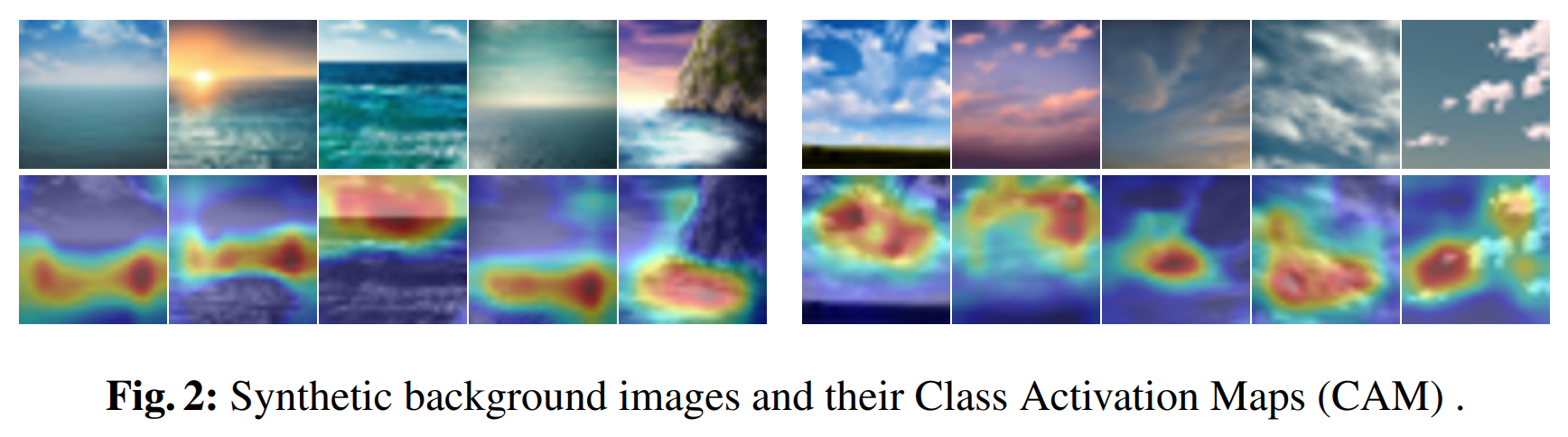
- To validate this phenomenon:
- Generated synthetic images using Stable Diffusion:
- One set with sea backgrounds only
- Another set with sky backgrounds only
- (No actual ships or airplanes included)
- Generated synthetic images using Stable Diffusion:
- Evaluation results (ResNet18 trained on CIFAR10):
- 56.10% of sea images → classified as ship
- 65.29% of sky images → classified as airplane
- CAM (Class Activation Map) analysis shows:
- Model focuses on:
- Sea horizon, waves
- Clouds, sky patterns
- → These are not intrinsic object features, but learned biases
- Model focuses on:
3-3. Key Insight
- Even without target objects:
- Models can classify inputs using bias-only information
- If a model had learned only object features:
- It should randomly guess on such synthetic images
- → But it does not
3-4. Motivation for Proposed Method
- Based on this observation:
- Intentionally inject class-wise hidden biases into the dataset
- Expected outcome:
- A model trained on such data will:
- Learn both task features and embedded biases
- A model trained on such data will:
- Key implication:
- The model can classify bias-only inputs
- → This property can be used to verify dataset usage
4. Method
- Bias has traditionally been regarded as a negative factor in deep learning because it can:
- Degrade model performance
- Introduce ethical problems such as gender or race bias
- For this reason, many previous studies have focused on debiasing techniques to remove such unwanted patterns
- In contrast, this paper takes a fundamentally different perspective:
- It intentionally embeds class-wise hidden biases into the dataset
- These hidden biases are used as a form of dataset watermark for copyright protection
- This main idea is:
- Instead of eliminating bias, exploit it as a verifiable signal
- A model trained on the watermarked dataset will learn these hidden class-specific biases
- This learned behavior can later be used to verify whether the dataset was used during training
4-1. Noise Patch Placement: Class-wise Bias Embedding
- The first approach introduces class-specific noise patches into the dataset to embed hidden bias
4-1-1. Method
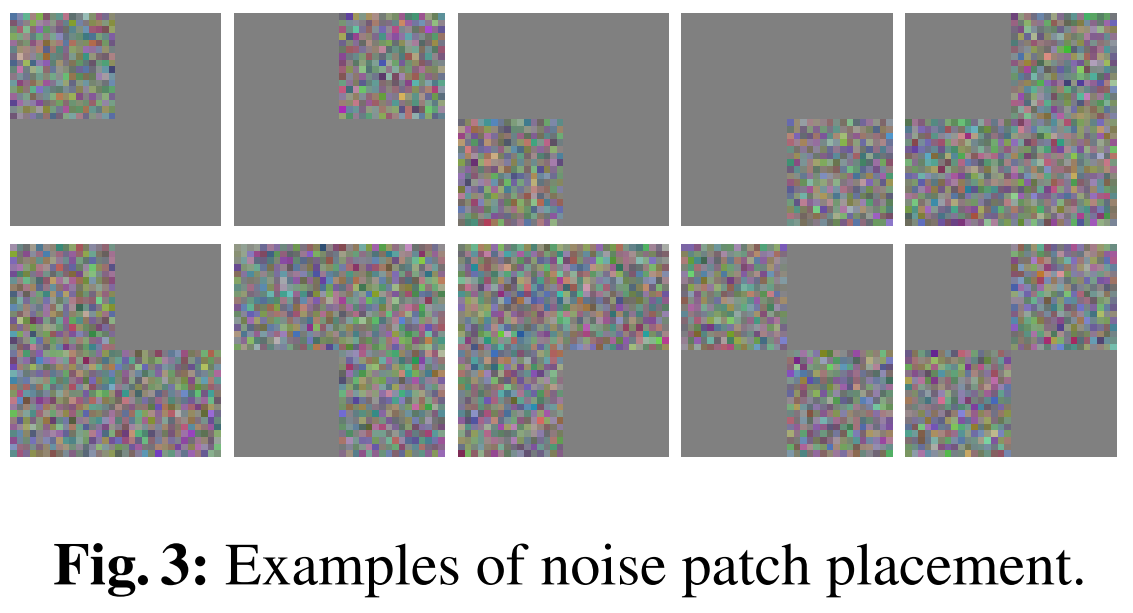
- For each class, a unique noise pattern is assigned and injected as:
- $\hat{x} = x + \lambda n$ $s.t.$ $y^x = y^n$
- $x$: original image
- $n$: class-specific noise (Gaussian $\mathcal{N}(0,I)$)
- $\lambda$: small scaling facotr (0.01)
- Label remains unchanged (clean-labeled)
- Note is:
- Placed at predefined, class-specific spatial locations
- Applied to 50% of training data
- $\hat{x} = x + \lambda n$ $s.t.$ $y^x = y^n$
4-1-2. Experimental Setup
- Model: ResNet18
- Dataset: CIFAR10
- Training:
- 100 epochs
- Adam optimizer + cosine decay
- Data augmentation applied
- Evaluation:
- Tested on noise-only images
4-1-3. Key Findings
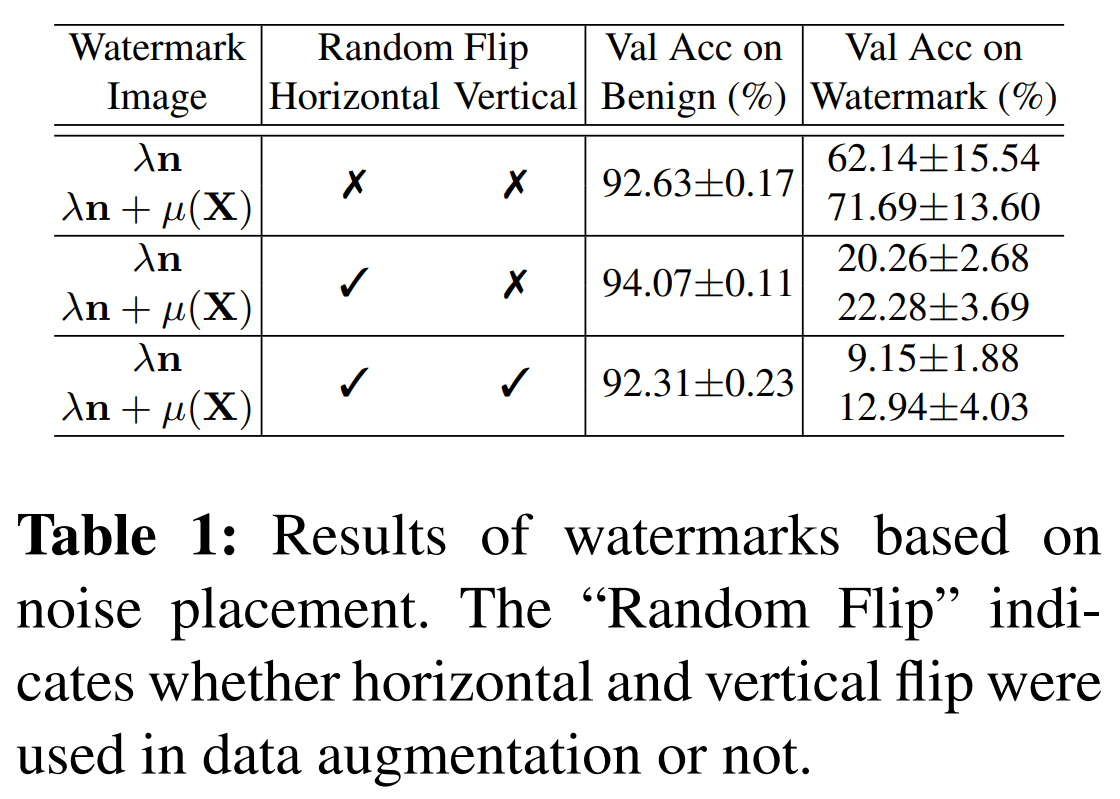
- Hidden bias can be embedded (clean-labeled)
- Even though noise images are very different from original images:
- Model achieves high accuracy on noise-only inputs
- -> Confirms feasibility of watermark via noise placement
- Even though noise images are very different from original images:
- Domain gap issue & solution
- Performance:
- $\lambda n$ alone -> lower accuracy
- $\lambda n + \mu (\mathcal{X})$ -> higher accuracy
- Reason:
- $\lambda n$ has near-zero mean -> differs from real image distribution
- Model tends to ignore it
- Solution:
- Add dataset mean $\mu (\mathcal{X})$
- -> Aligns distribution -> improves classification
- Performance:
- Sensitivity to spatial transformations
- Performance drops significantly with data augmentation:
- No flip -> ~60% accuracy
- Horizontal flip -> ~20%
- Horizontal + vertical flip -> ~12%
- Cause:
- Noise patterns are location-dependent
- Flip/rotations distort pattern consistency
- Performance drops significantly with data augmentation:
4-1-4. Limitation
- Noise-based watermark is:
- Not robust to spatial transformations (flip, rotation, translation)
- -> It leads to unstable verification
4-2. Overlaying Auxiliary Dataset: Robust Bias to Augmentation
- To address the lack of robustness to spatial transformations in noise-based methods, a more stable bias pattern is required
4-2-1. Method
- Instead of manually designing patterns, the method uses an auxiliary dataset to generate robust class-wise bias
- Watermarking is performed as:
- $\hat{x}=(1-\lambda) x + \lambda x$ $s.t.$ $y^x=y^z$
- $(z, y^z)$: auxiliary data and its label
- $x$: target dataset sample
- $z$: auxiliary dataset sample
- $\lambda$: mixing coefficient
- Labels are aligned (clean-labeled setting)
- $\hat{x}=(1-\lambda) x + \lambda x$ $s.t.$ $y^x=y^z$
4-2-2. Label Alignment Strategy
- Even if two datasets are semantically unrelated:
- Only class indices are matched
- Example:
- select $x$ from CIFAR10: ‘airplane’ -> $y^x = $ ‘Class 0’
- select $z$ from Fashion-MNIST: pullover -> $y^z = $ ‘Class 0’
- -> corresponding $y^x$ and $y^z$ could both be denoted as ‘Class 0’
- i.e., overlay both samples as same class
4-2-3. Experimental Setup
- Target dataset: CIFAR10
- Auxiliary dataset: Fashion-MNIST
- Model: ResNet18
- Training: same as noise patch experiment
4-2-4. Key Findings
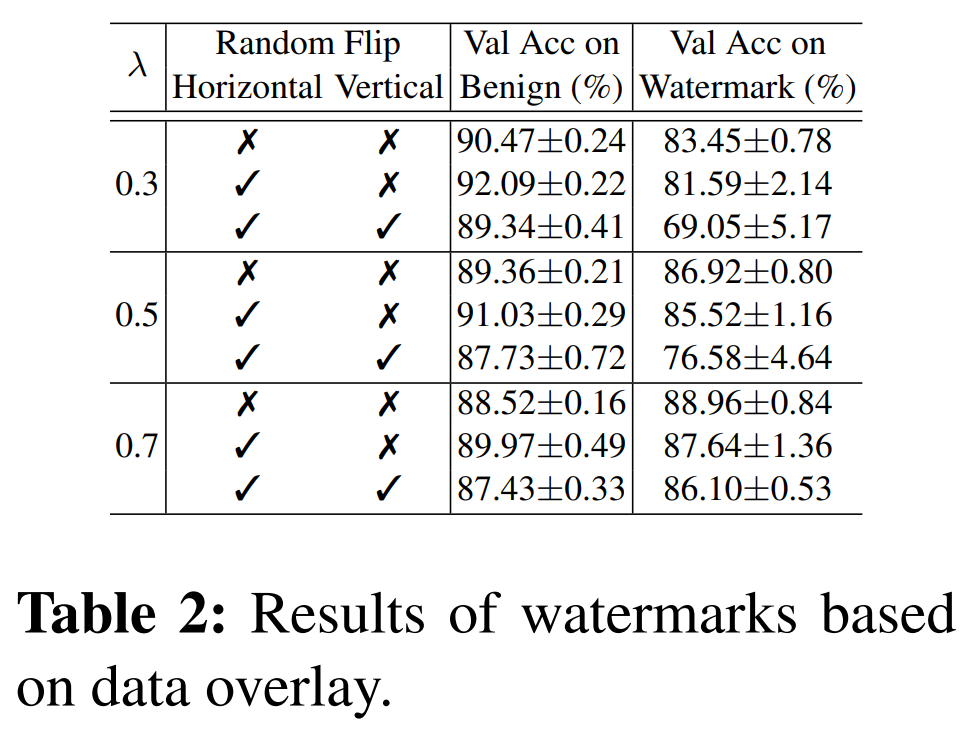
- Strong robustness to augmentation
- Overlaid patterns are:
- Distributed across the image
- Not tied to a specific location
- -> Robust to flip, rotation, etc.
- Overlaid patterns are:
- Effective hidden bias learning
- Model successfully learns:
- Auxiliary dataset patterns as class-specific bias
- -> Works as a strong watermark signal
- Model successfully learns:
4-2-5. Limitations
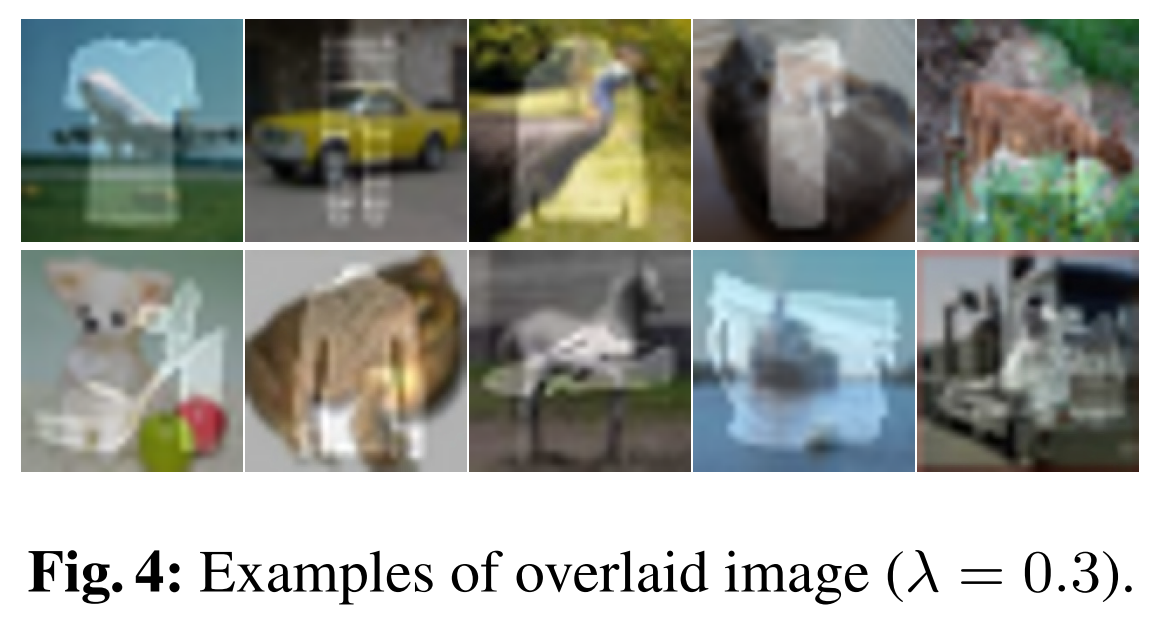
- Highly visible watermark
- Overlay significantly alters image appearance
- Easily detectable by human inspection
- Performance degradation
- Large deviation from original data distribution
- -> Lower validation accuracy on benign task
- Practical vulnerability
- Can be removed or filtered visually
4-3. Undercover Bias: Invisible Bias Embedding
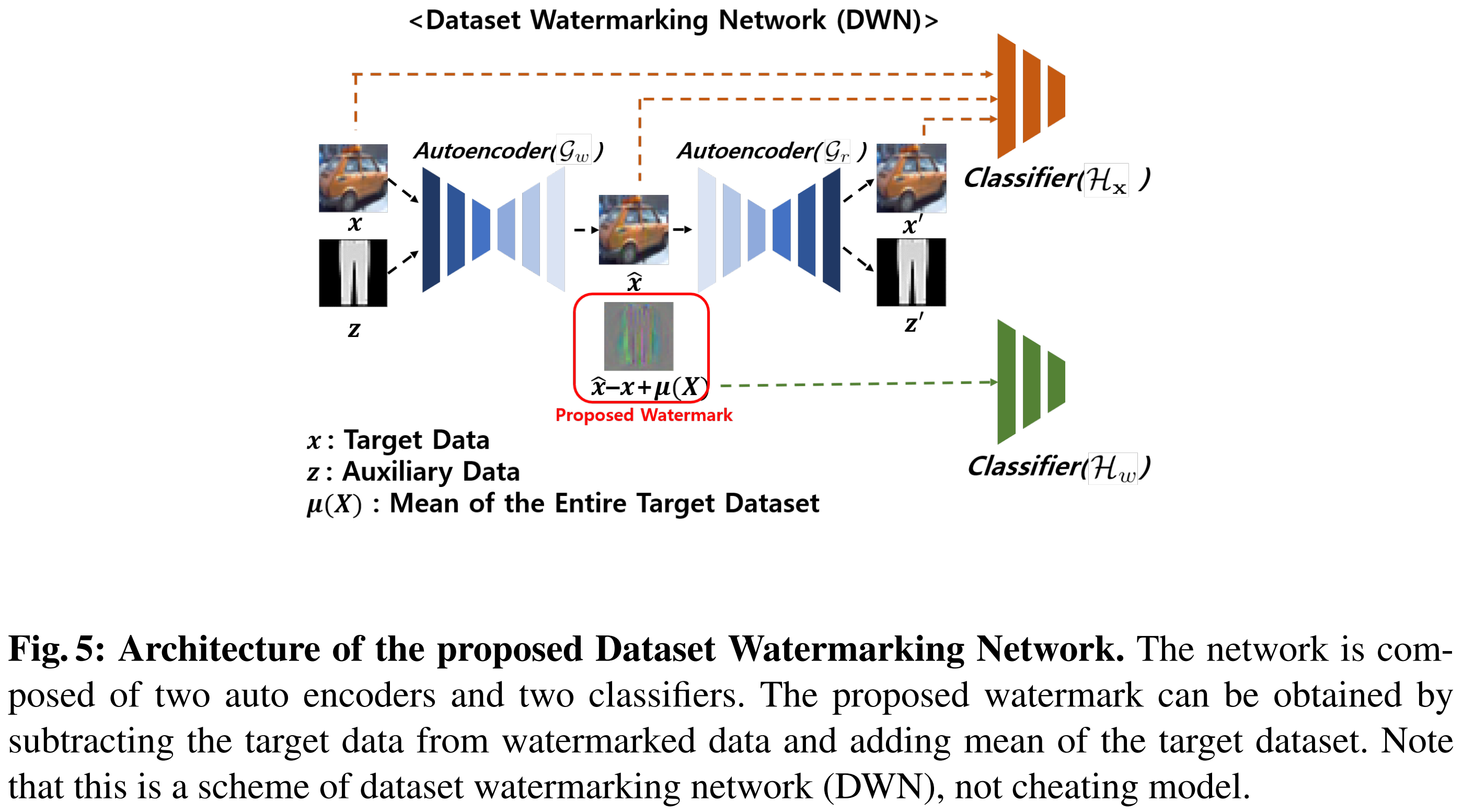
- Based on previous methods, an effective watermark must satisfy:
- Robustness to spatial transformations
- Near invisibility to human perception
- To achieve this, the paper proposes an invisible watermarking method using:
- Image steganography
- Auxiliary dataset
4-3-1. Overall Framework
- Watermarked image generation:
- $\hat{x}=DWN(x,z)$
- Watermark definition
- $w = \hat{x} - x$
- $y^w = y^z$
- $x$: original image
- $z$: auxiliary image
- $\hat{x}$: watermarked image
- $w$: hidden watermark
- Label of watermark follows auxiliary data
4-3-2. Dataset Watermarking Network (DWN)
- A neural network designed to:
- Hide auxiliary information inside the image
- While keeping the image visually unchanged
- Components
- Hiding Network ($G_w$)
- Input: $x$, $z$
- Output: $\hat{x}$ (visually similar to $x$)
- Reconstruction Network ($G_r$)
- Input: $\hat{x}$
- Output:
- $x’$: reconstructed original image
- $z’$: reconstructed auxiliary signal
- $\hat{x}=G_w(x, z, \theta_{G_{w}})$
- $x’,z’=G_r(\hat{x}, \theta_{G_{r}})$
- $\theta_{G_{w}}$: weight of the autoencoder $G_w$
- $\theta_{G_{r}}$: weight of the autoencoder $G_r$
- Hiding Network ($G_w$)
4-3-3. Training Objective
- Train all components jointly using:
- L1 loss (reconstruction)
- Cross-entropy loss (classification)
- Loss components
- Reconstruction constraints
- Preserve original image: $\vert x - \hat{x} \vert$, $\vert x - x’ \vert$
- Preserved embedded signal: $\vert z - z’ \vert$
- Perceptual (classification) constraints
- $H_x$: ensures original task performance
- $x$, $\hat{x}$, $x’$ all classified correctly
- $H_w$: ensures watermark encodes class-wise information
- Extracted watermark corresponds to $y^z$
- $H_x$: ensures original task performance
- Reconstruction constraints
- Reconstruction loss
- $\lambda_1^G \vert x - \hat{x} \vert + \lambda_2^G \vert x - x’ \vert + \lambda_3^G \vert z - z’ \vert$
- $\vert x - \hat{x} \vert$: watermarked image should be close to the original (watermark invisibility)
- $\vert x - x’ \vert$: reconstructed image $x’$ should match the original (prevent information loss)
- $\vert z - z’ \vert$: embedded auxiliary information should be recoverable (ensures watermark is properly encoded)
- $\lambda_1^G \vert x - \hat{x} \vert + \lambda_2^G \vert x - x’ \vert + \lambda_3^G \vert z - z’ \vert$
- Origianl task loss (for classify $y^x$)
- $\lambda_1^H \mathcal{L}{CE}(H_x(x), y^x) + \lambda_2^H \mathcal{L}{CE}(H_x(\hat{x}), y^x) + \lambda_3^H \mathcal{L}_{CE}(H_x(x’), y^x)$
- $H_x(x)$: ensures correct classification of the original image (baseline)
- $H_x(\hat{x})$: maintains performance even after watermark embedding (prevents degradation)
- $H_x(x’)$: ensures reconstructed image is still meaningful and classifiable
- $\lambda_1^H \mathcal{L}{CE}(H_x(x), y^x) + \lambda_2^H \mathcal{L}{CE}(H_x(\hat{x}), y^x) + \lambda_3^H \mathcal{L}_{CE}(H_x(x’), y^x)$
- Watermark training loss (for classify $y^z$)
- $\lambda_4^H \mathcal{L}_{CE}(H_w(x’ - x + \mu(X)), y^z)$
- $x’ - x + \mu(X)$
- $x’ - x = w$, i.e., watermark $w$
- $\mu(X)$: mean image of the target dataset $X$
- This formulation enables classification of auxiliary labels using only the watermark
- $\lambda_4^H \mathcal{L}_{CE}(H_w(x’ - x + \mu(X)), y^z)$
- Final loss formulation
- $\lambda_1^G \vert x - \hat{x} \vert + \lambda_2^G \vert x - x’ \vert + \lambda_3^G \vert z - z’ \vert + \lambda_1^H \mathcal{L}{CE}(H_x(x), y^x) + \lambda_2^H \mathcal{L}{CE}(H_x(\hat{x}), y^x) + \lambda_3^H \mathcal{L}{CE}(H_x(x’), y^x) + \lambda_4^H \mathcal{L}{CE}(H_w(x’ - x + \mu(X)), y^z)$
4-3-4. Practical Design Choice
- Instead of using many classifiers for model-agnostic training:
- Use a simple CNN with dropout
- Includes:
- Spatial dropout
- Standard dropout
4-3-5. Key Property
- After training:
- Watermarked images can be generated without retraining
- Watermarks are:
- Invisible
- Robust
- Class-discriminative
4-4. Discussion
4-4-1. Issue: Number of Classes
- To ensure correct pairing:
- $y^x = y^w$
- -> Target data and watermark must share the same label
- Problem:
- The auxiliary (watermark) dataset may have fewer or different number of classes than the target dataset
- Direct one-to-one class matching becomes difficult
- Solution: Modulo Operation
- $y^x \equiv y^w (mod N_{cls}^w)$
- $N_{cls}^w$: number of classes in the watermark (auxiliary) dataset
- Enables:
- Flexible class pairing even when class counts differ
- Reuse of watermark classes across multiple target classes
4-4-2. Verification Metric (Black-box Setting)
- Assumption:
- Only predicted class outputs are available (strict black-box)
- Metric used: Mean Class Accuracy (mAcc)
- $\frac{1}{N_{cls}^w} \sum_{c=1}^{N_{cls}^w} \mathbb{P}\big(F(\mu(X) + w, \theta_F) = c \mid y^w = k \big) > \tau$
- Key idea:
- Evaluate model performance on watermark-only inputs:
- $\mu(X) + w$
- Evaluate model performance on watermark-only inputs:
- Interpretation
- Clean model
- Has not seen watermark -> performs poorly (near random)
- Cheating model
- Learned watermark -> achieves high mAcc
- Decision rule:
- If mAcc $>$ threshold $\tau$ -> suspect dataset misues
- Clean model
4-4-3. Handling Different Class Sizes
- If target and auxiliary datasets differ in class count:
- $F(\mu(X) + w, \theta_F) \equiv k (mod N_{cls}^w)$
- Ensures consistent evaluation under modulo mapping
4-4-4. Threshold Determination
- Goal:
- Define a threshold that clean models cannot reach by chance
- Assumption
- mAcc of a clean model follows:
- Approximately Gaussian-like distribution
- Centered at: {$\frac{1}{N_{cls}^w}$}
- mAcc of a clean model follows:
4-4-5. Trade-Off
- More precise thresholds:
- Require estimating full distribution -> computationally expensive
- Proposed solution:
- Use $2/N_{cls}^{w}$ as a lightweight and practical heuristic
5. Experiments I: Comparison with Prior Works
- This section compares the proposed method with:
- Backdoor attacks
- Data poisoning
- Radioactive data
- Evaluation aspects:
- computational cost
- Invisibility
- Harmlessness (impact on original task)
- Verification ability
- Dataset used: CIFAR 10
5-0-1. Experimental Setup
- For all methods:
- 50% of training data is watermarked/modified
5-0-2. Backdoor Attacks
- Two types considered:
- Label-noised backdoor
- Methods:
- BadNets (Gu, et al., “Badnets: Evaluating backdooring attacks on deep neural networks”, IEEE Access 7, 2019.)
- Blended (Chen, et al., “Targeted backdoor attacks on deep learning systems using data poisoning”, arXiv:1712.05526, 2017.)
- Used only for basic specification comparison
- Methods:
- Clean-labeled backdoor
- Methods:
- Hidden Trigger (Saha, et al., “Hidden trigger backdoor attacks”, AAAI, vol. 34, 2020.)
- Sleeper Agent (Souri, et al., “Sleeper agent: Scalable hidden trigger backdoors for neural networks trained from scratch”, NeurIPS, 2022.)
- Setup
- 10 distinct triggers
- One trigger assigned per class
- Methods:
5-0-3. Data Poisoning
- Methods:
- Poison Frogs (Shafahi, et al., “Poison frogs! targeted clean-label poisoning attacks on neural networks”, NeurIPS, 2018.)
- MetaPoison (Huang, et al., “Metapoison: Practical general purpose clean-label data poisoning”, NeurIPS, 2020.)
- Bullseye (Aghakhani, et al., “Bullseye polytope: A scalable clean-label poisoning attack with improved tranferability”, EuroS&P, 2021.)
- Gradient Matching (Geiping, et al., “Witches’ brew: Industrial scale data poisoning via gradient matching”. ICLR, 2021.)
- Setup:
- 1 verification image per class
- Total: 10 verification images
- Multi-target setting
- 5% poisoning budget per verification sample
5-0-4. Radioactive Data
- Method: Radioactive Data (Sablayrolles, et al., “Radioactive data: tracing through training”, ICML, 2020.)
- Setup:
- 50% of training data marked
- Entire test set also marked
5-0-5. Reference Model
- Required for prior methods:
- Used ResNet18 trained on clean CIFAR10
- Implementation:
- Below official codes were used
- (Geiping, et al., “Witches’ brew: Industrial scale data poisoning via gradient matching”, ICLR, 2021.)
- (Sablayrolles, et al., “Radioactive data: tracing through trainig”, ICML, 2020.)
- (Souri, et al., “Sleeper agent: Scalable hidden trigger backdoors for neural networks trained from scratch”, NeurIPS, 2022.)
- Below official codes were used
5-0-6. Proposed Method
- Approach
- Embed watermark using auxiliary dataset (Fashion-MNIST)
- Architecture:
- Pre-trained DWN (Dataset Watermarking Network)
- Autoencoder: U-Net (Ronneberger, et al., “U-net: Convolutional networks for biomedical image segmentation”, MICCAI, 2015.)
- Classifiers: Vanilla CNN (4 conv layers + dropout)
- Pre-trained DWN (Dataset Watermarking Network)
- Setup:
- Watermark applied to 50% of training data
5-1. Comparison in Fundamental Specifications
5-1-1. Evaluation Criteria
- Harmlessness
- Measured by validation accuracy on benign data
- Higher accuracy -> less impact on original task
- Time Cost
- Measured as watermarking time per image
- Excludes:
- DWN training time
- Reference model training time
- Invisibility
- Measured using SSIM (Structural Similarity Index)
- Between:
- Original image
- Watermarked image
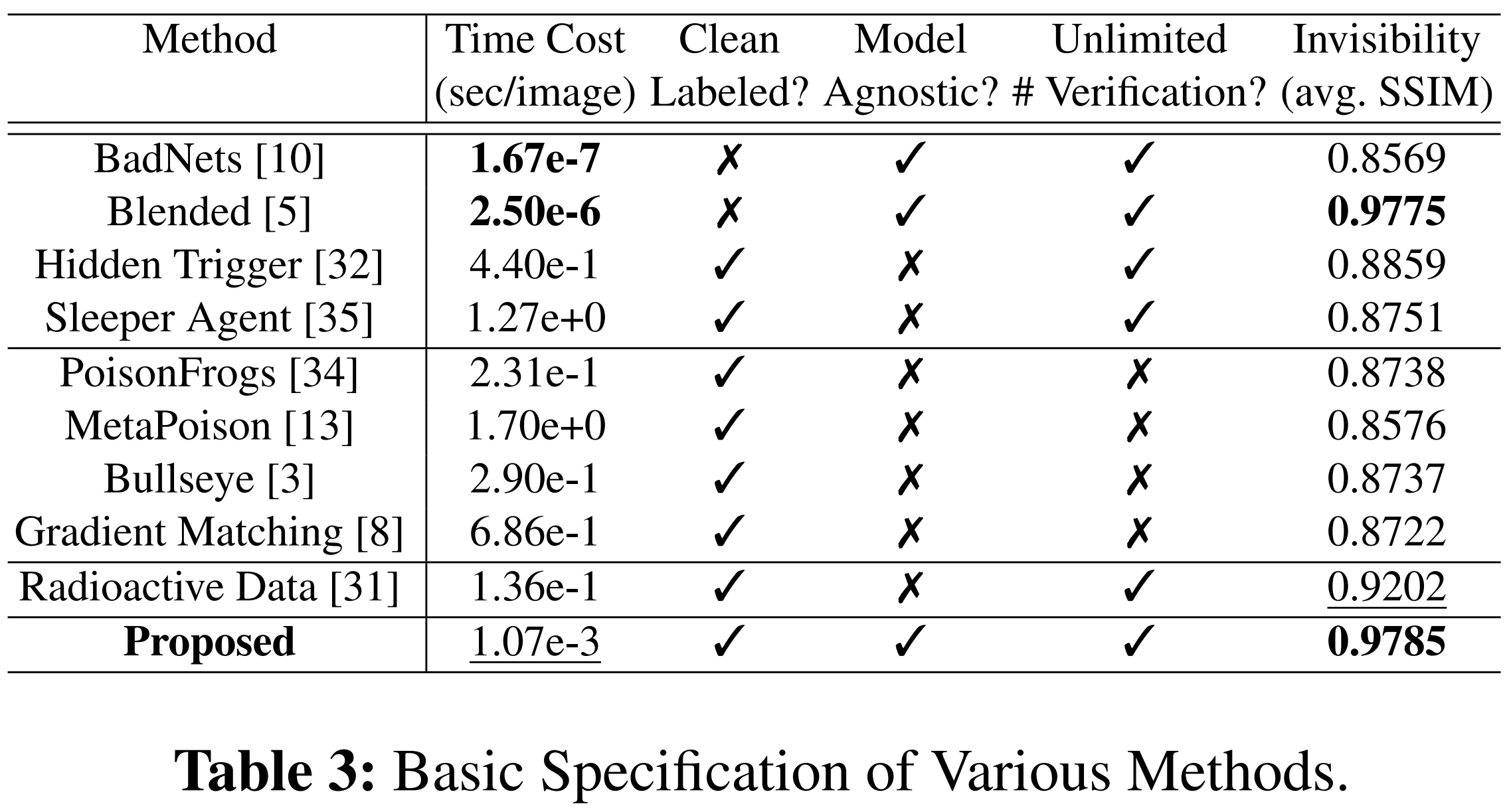
5-1-2. Observations on Prior Methods
- Label-noised backdoor attacks
- Easily detectable via visual inspection
- Due to incorrect labels
- Clean-labeled backdoor, data poisoning, radioactive data
- Require reference models
- -> Model-dependent
- -> Computationally expensive
- Often produce visible artifacts
- Data poisoning
- Limited to a small number of victim samples
- -> Weak scalability for verification
5-1-3. Advantages of Proposed Method
- High invisibility
- Generate less perceptible watermarks
- Model-agnostic
- Does not depend heavily on reference models
- Efficient
- Faster watermarking process
- Scalable verification
- No restriction on the number of watermark samples
5-2. Comparison in Effectiveness of Watermark
5-2-1. Purpose
- Evaluate effectiveness of watermarking methods in terms of:
- Harmlessness (impact on original task)
- Verifiability (ability to detect dataset usage)
- Compared methods
- Backdoor attacks
- Data poisoning
- Radioactive data
- Proposed method
5-2-2. Experimental Setting
- Dataset: CIFAR10
- For all methods:
- 50% of training data randomly watermarked
5-2-3. Training Scenarios
- Experiments conducted under three settings
- ResNet18 (from scratch)
- 100 epochs
- MobileNetV2 (from scratch)
- 300 epochs
- MobileNetV2 (ImageNet pre-trained)
- 100 epochs
- Each scenario:
- Repeated 10 times
- With data augmentation
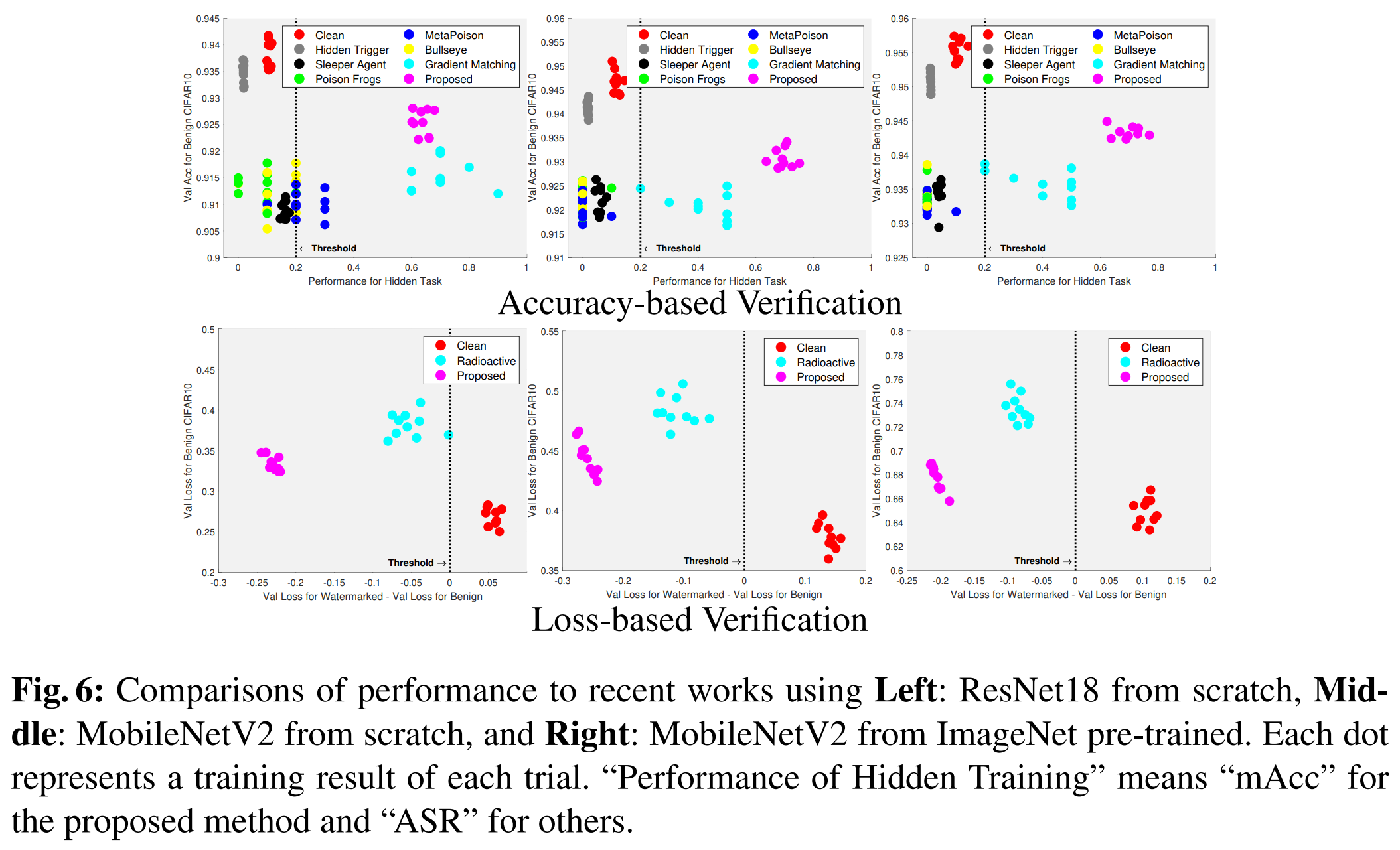
5-2-4. Evaluation Metrics
- Harmlessness
- Measured using validation accuracy on benign dataset
- For data poisoning, excluded 10 verification images to ensure fair evaluation
- Verification Ability
- Backdoor attacks & Data poisoning
- ASR (Attack Success Rate)
- Measures success rate of intended misclassification
- ASR (Attack Success Rate)
- Radioactive data
- Difference between:
- Validation loss on benign data
- Validation loss on radioactive-marked data
- Difference between:
- Proposed method
- Uses multiple metrics:
- mAcc (mean class accuracy on watermark)
- ASR
- Loss difference
- Uses multiple metrics:
- Backdoor attacks & Data poisoning
5-3. Results
6. Experiments II: General Applicability
- The previous experiments validated the method in limited settings (mainly CIFAR10)
- This section evaluates whether the proposed method:
- Generalizes across datasets
- Works on different model architectures
- Remains effective under varied tasks
6-1. Application to Further Architectures and Datasets
6-1-1. Purpose
- Extend evaluation beyond CIFAR10 and a few models
- Verify robustness and general applicability of the method
6-1-2. Experimental Setting
- Datasets
- CIFAR100 (100 classes)
- FER2013 (7 classes)
- Fashion-MNIST
- Compared Methods
- Backdoor attack: Sleeper Agent (best-performing prior method)
- Data poisoning: Gradient Matching (best-performing prior method)
- Models
- Reference models
- ResNet18
- Simple (benign) CNN
- Cheating models
- DenseNet-BC (trained from scratch)
- Reference models
- Auxiliary Datasets
- CIFAR100: Fashion-MNIST + MNIST (each with 10 classes)
- FER2013: First 7 classes of MNIST
- Additional Architecture Evaluation
- Test on CIFAR10 (target) + Fashion-MNIST (auxiliary) with:
- EfficientNet
- PVTv2
- ResMLP
- PiT
- Training Setup:
- ImageNet pre-trained initialization
- 35 epochs
- SGD optimizer
- Warmup + label smoothing
- Data augmentation: Spatial transformations, Mixup
- Multiple runs for robustness
- Test on CIFAR10 (target) + Fashion-MNIST (auxiliary) with:
6-1-3. Results
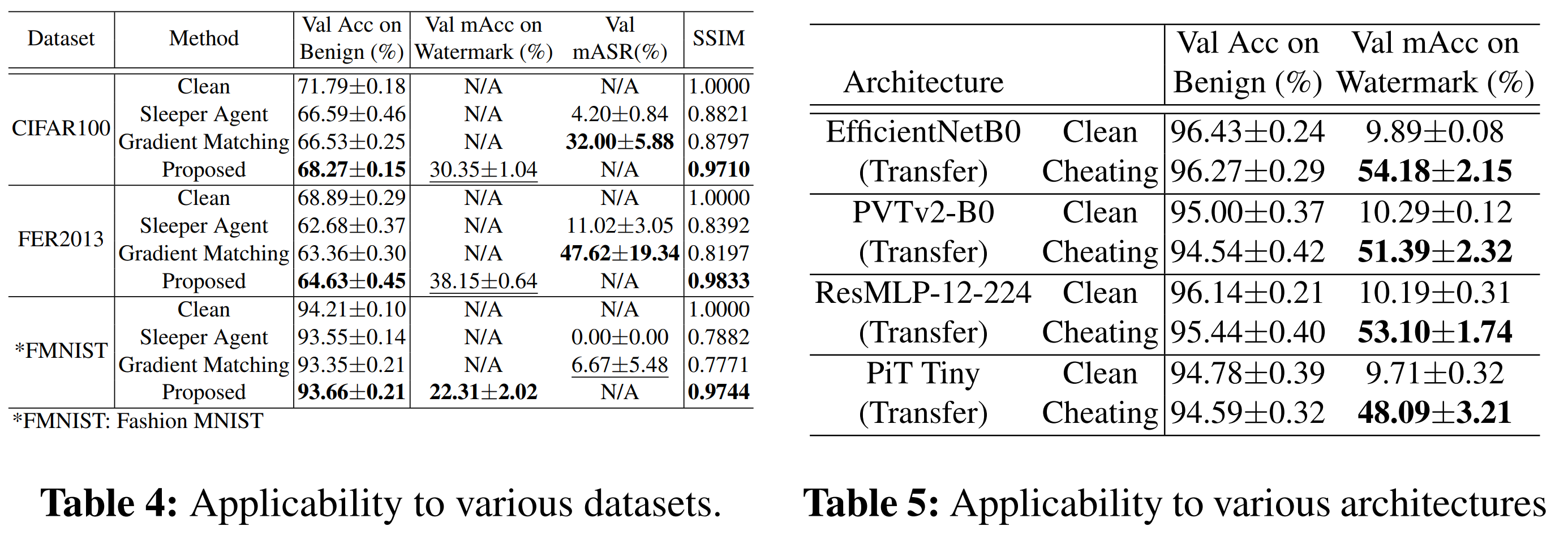
- The proposed method consistently demonstrates
- Harmlessness: Minimal degradation in original task performance
- Invisibility: Watermarks remain imperceptible across datasets
- Verifiability: Strong performance in detecting dataset usage
6-1-4. Additional Findings
- mAcc (watermark classification accuracy):
- Consistently higher than prior methods across architectures
- Threshold performance:
- Achieved 100% accuracy in distinguishing:
- Clean models vs. cheating models
- Achieved 100% accuracy in distinguishing:
6-2. Application to Fine-grained Classification
6-2-1. Purpose
- Address a key limitation:
- Auxiliary dataset is typically required to have equal or more classes than the target dataset
- Solution:
- Use modulo operation to enable class matching even when target dataset has more classes than auxiliary dataset
6-2-2. Experimental Setting
- Datasets
- Tiny ImageNet (100 classes)
- ImageNet (1,000 classes)
- Auxiliary dataset:
- Fashion-MNIST (10 classes)
- Setup
- 50% of training data watermarked
- Model: MobileNetV2
- Training configurations:
- Tiny ImageNet
- Trained from scratch
- SSIM: 0.9883
- ImageNet
- Initialized from pre-trained ImageNet model
- SSIM: 0.9570
- Tiny ImageNet
6-2-3. Results
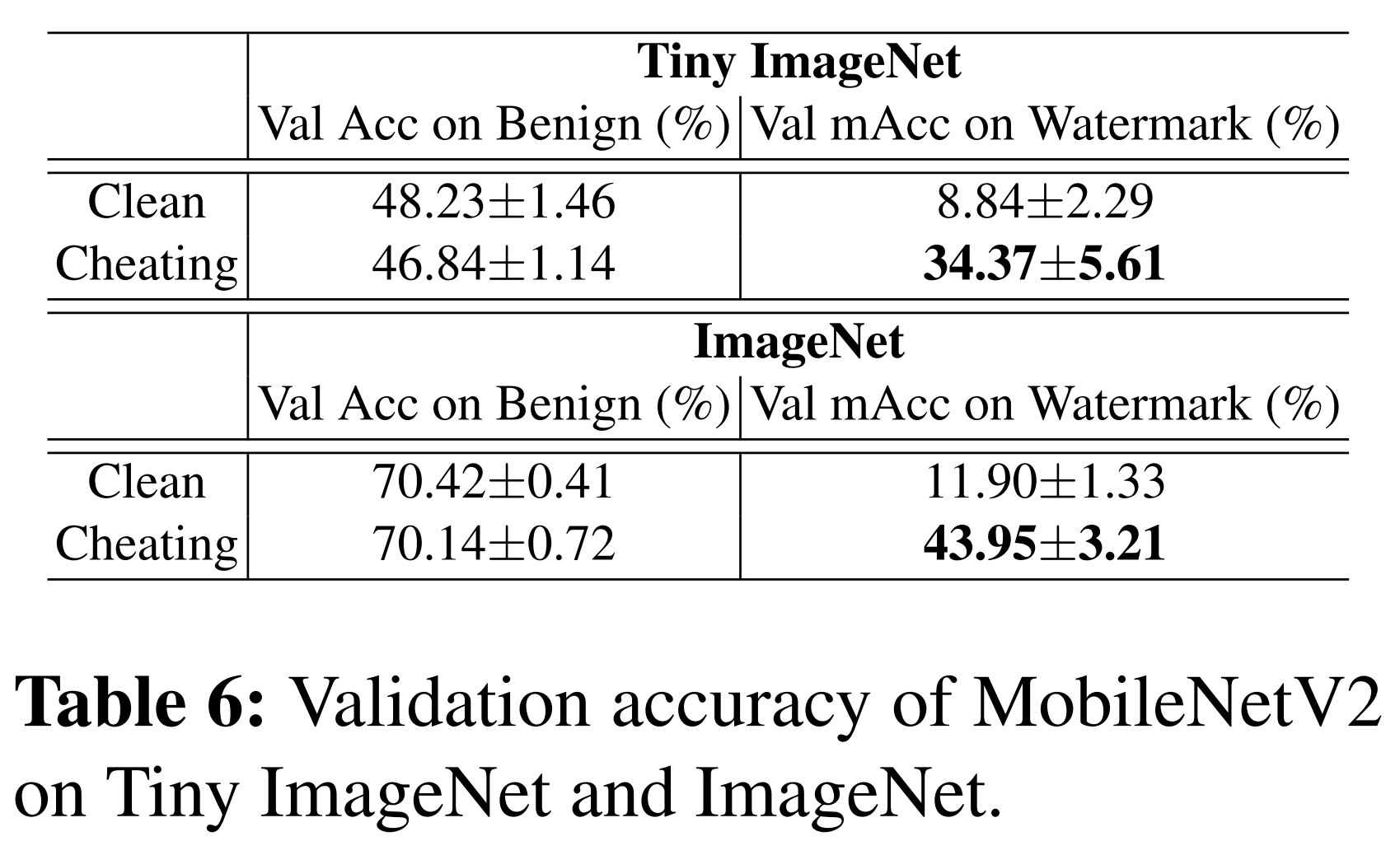
- Based on multiple trials:
- Tiny ImageNet: 30 runs
- ImageNet: 5 runs
- Harmlessness: Slight decrease in validation accuracy on benign data
- Verifiability: Significant improvement in detecting watermark signals
- Clean model behavior: Performance on watermark inputs drops to near chance level
6-2-5. Implication
- Even when target dataset has far more classes than auxiliary dataset -> The proposed method still works effectively
6-3. Application to Image Segmentation
6-3-1. Purpose
- Extend the proposed watermarking method from image classification to image segmentation
- Key challenge:
- Segmentation requires pixel-level predictions, not image-level labels
6-3-2. Method Adaptation
- Introduce spatially varying watermarks:
- Auxiliary data is:
- Resized to small patches (e.g., 8x8 pixels)
- Repeatedly stitched onto image segments
- Each patch is aligned with:
- The label of the corresponding segment
- Auxiliary data is:
- Applied to 50% of PASCAL VOC 2012 dataset
6-3-3. Model Adjustment
- Modified DWN:
- Replace classification heads with autoencoders + dropout
- Backbone:
- MobileNetV2
- Training setup:
- From scratch
- Adam optimizer (initial LR = 1e-3, with decay)
- Batch size = 60
- Data augmentation applied
6-3-4. Threshold Adjustment
- In segmentation:
- Important information lies in object shapes (silhouettes)
- Therefore:
- Requires a higher verification threshold than $\frac{2}{N_{cls}^w}$
6-3-5. Evaluation Metrics
- Task performance
- Measured by mIoU (mean Intersection over Union)
- Verification
- Measured by:
- Mean class pixel accuracy
- On masked (watermark) regions
- Measured by:
6-3-6. Results
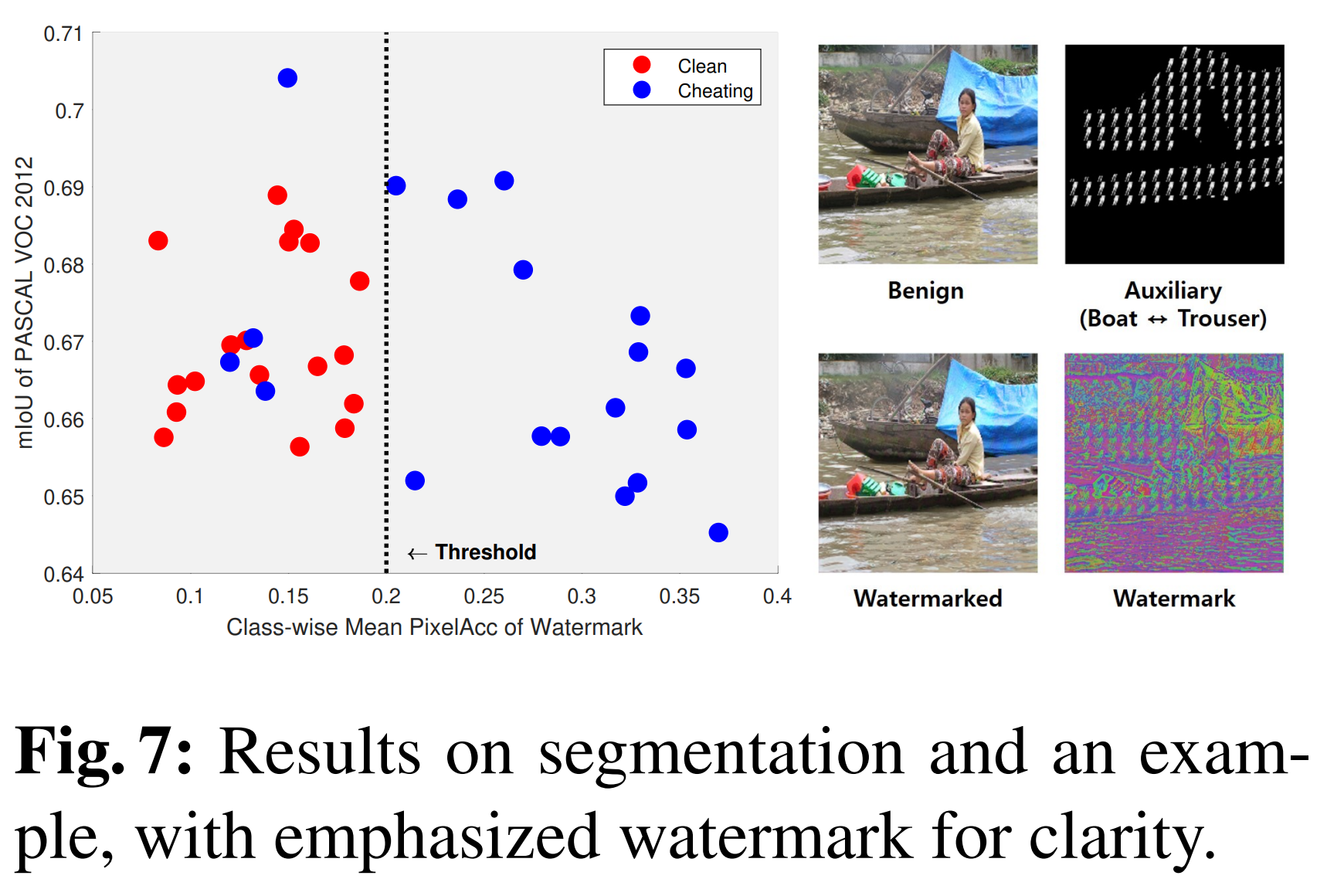
- Harmlessness
- Minimal degradation in segmentation performance
- Verifiability
- Watermark successfully learned in most trials
- Performance comparison
- Clean models: accuracy < 0.2
- Cheating models: 79% of trials -> accuracy > 0.2
7. Ablation Studies
7-1. Histogram Analysis of mAcc on Watermark
7-1-1. Purpose
- Validate the threshold criterion used for detecting cheating models
- $\tau = \frac{2}{N_{cls}^w}$
7-1-2. Experimental Setting
- Models:
- ResNet18 on CIFAR10
- DenseNet on CIFAR100
- Training:
- With and without watermark
- From scratch
- Optimizer: Adam (learning rate = 1e-3)
- Epochs: 100
- Scale:
- 300+ training runs per setting
- Evaluation:
- Measure mAcc on watermark
- Analyze distribution via histograms
7-1-3. Results
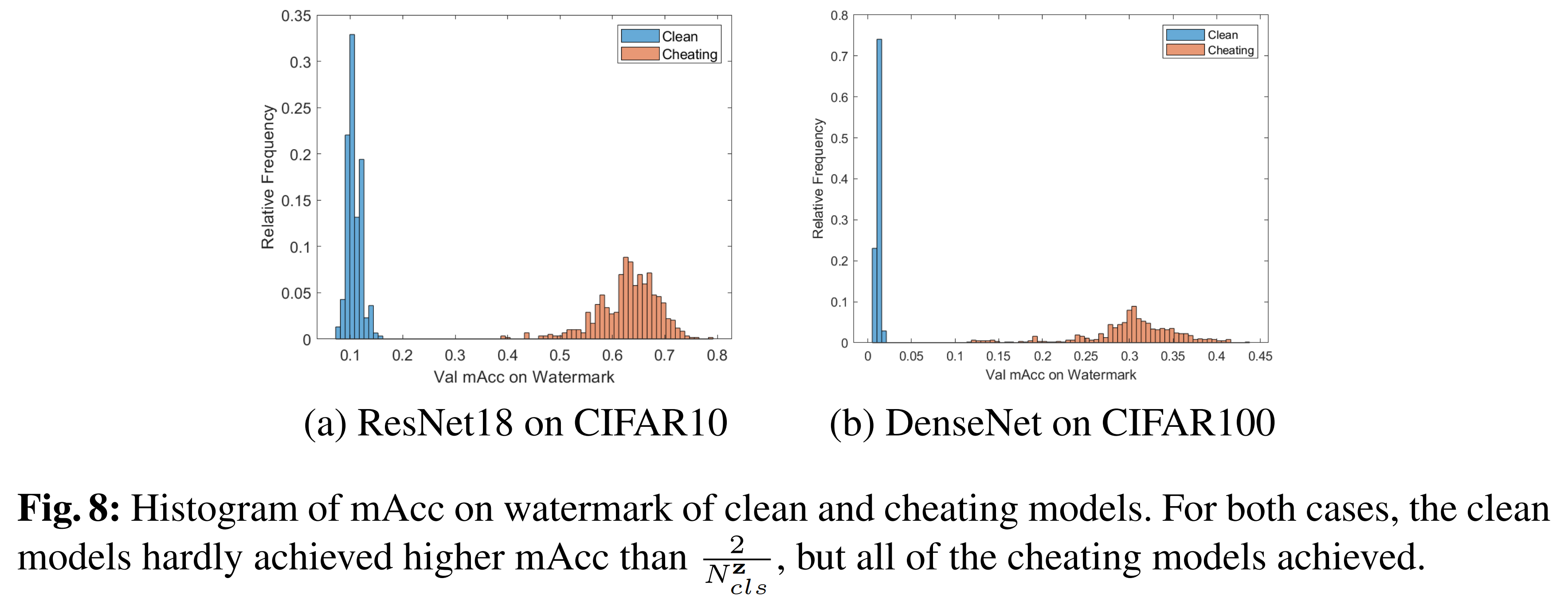
-
mAcc values follow a Gaussian-like distribution
-
Observations
- Clean models rarely approach to $\frac{2}{N_{cls}^w}$
- Chaeting models all exceed $\frac{2}{N_{cls}^w}$
- No samples observed:
- At 0% mAcc
- At exactly $\frac{2}{N_{cls}^w}$
7-1-4. Statistical Interpretation
- Threshold: $\frac{2}{N_{cls}^w}$
- Corresponds to: ~7× and ~5× standard deviation from the mean
- Clean model exceeding threshold probability: $< 3 \times 10^{-5}$
7-2. Visualizations
7-2-1. Purpose
- Analyze how the watermark is learned using:
- t-SNE (feature space visualization)
- CAM (Class Activation Map)
- Goal:
- Understand whether models actually learn hidden bias (watermark)
7-2-2. Experimental Setting
- Two models trained:
- Clean model: trained on benign CIFAR10
- Cheating model: trained on watermarked CIFAR10
- Procedure:
- Extract last-layer latent features
- Visualize using:
- 2D t-SNE plots
- CAM heatmaps
7-2-3. Results
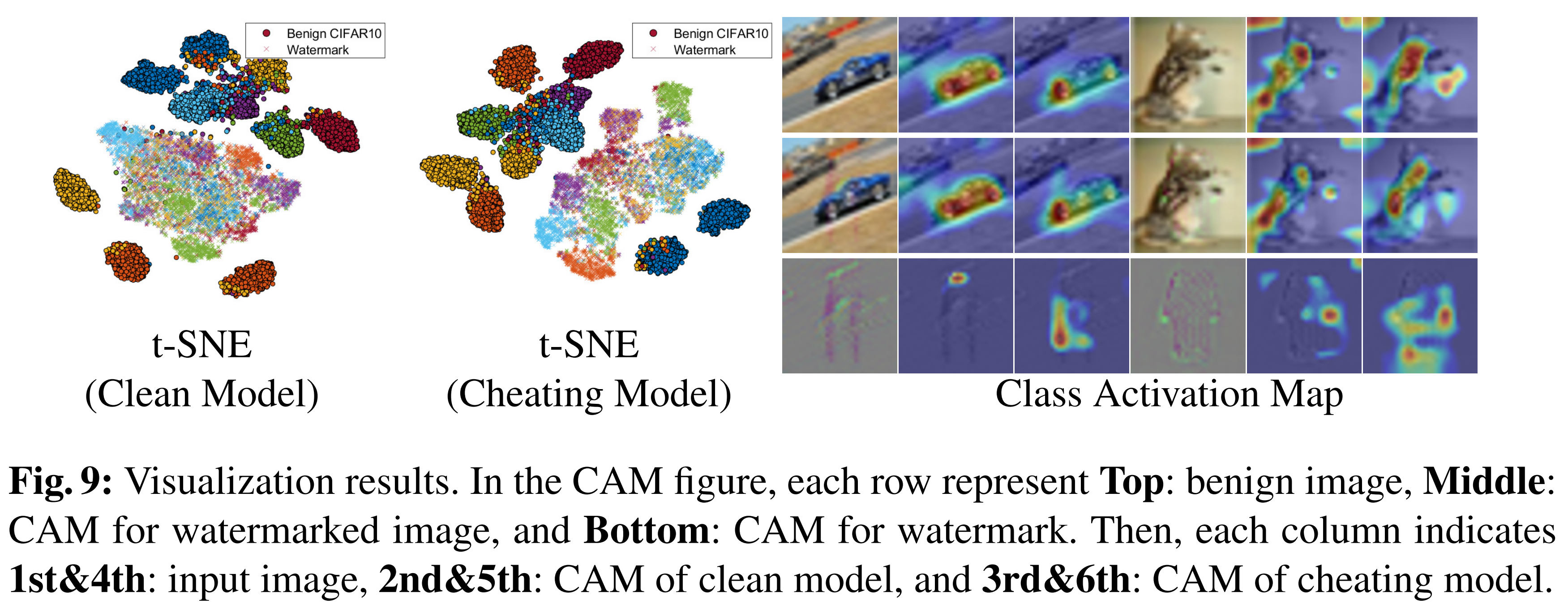
- t-SNE Analysis
- Benign data
- Both clean and cheating models show clear and well-separated clusters
- -> Normal feature learning
- Watermark data
- Cheating model shows partial clustering
- Clean model shows no clustering structure
- Interpretation: Only the cheating model learns meaningful representations of watermark
- Benign data
- CAM Analysis
- Cheating model
- Responds to benign images, watermarked images, watermark-only inputs
- Clean model
- Responds only to benign images
- Ignores watermark signals
- Cheating model
8. Conclusion & Limitations
- This paper proposes “undercover bias”, a novel dataset watermarking method:
- Embeds class-wise hidden bias into the dataset
- Enables detection of models trained on that dataset
8-1. Core Idea
- Models trained on watermarked data:
- Unintentionally learn hidden bias
- Respond to watermark signals
- This behavior serves as evidence of dataset misuse (cheating)
8-2. Key Contributions
- Observed that:
- Models can classify background-only images
- → Indicates unintended bias learning
- Developed two preliminary methods:
- Noise patch placement
- Dataset overlay
- Identified key requirements:
- Robustness to spatial transformations
- Invisibility
- Proposed final method:
- Undercover bias satisfying both requirements
8-3. Effectiveness
- Compared to prior methods:
- More reliable verification
- Less visible watermark
- Less impact on task performance
- Additional validation:
- Ablation studies
- Visualization analysis
8-4. Generalization
- Successfully applied to:
- Fine-grained classification
- Image segmentation
- Demonstrates:
- Broad applicability across tasks and settings
8-5. Limitations
- Not applicable to text data
- Small perturbations can drastically change meaning
- Slight performance degradation
- Watermarked models perform marginally worse than clean models

댓글 남기기